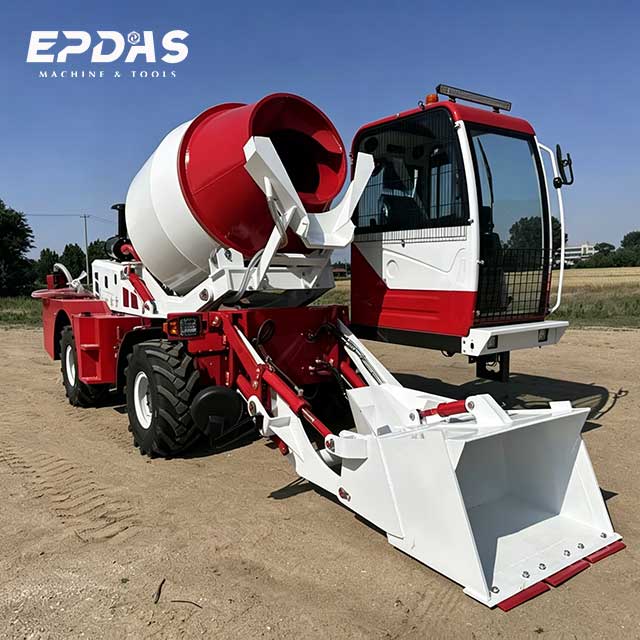
Six Competitiveness of 1.8m3 self loading concrete mixer – Core Advantages
The advantage of production efficiency
In the traditional construction mode, it takes 5-10 minutes for the loader to load, 10-15 minutes for the mixing station to mix, and the round-trip transportation of the tank truck takes longer. The self loading cement mixer truck single operation cycle only takes about 12 minutes, which is 2-3 times that of the traditional model.
The advantage of venue adaptability
The weight of the mobile self loading cement mixer is only 6300kg, the body is lighter, and the requirements for road conditions are low; the hinged steering design, with a turning radius of only 2355mm, can easily pass through narrow passages, country roads and other complex road conditions.
Manpower cost advantage
The traditional model requires 3-4 people (loader driver, mixing station operator, transport truck driver, unloader). A small self loading concrete mixer truck can replace the loader + mixing station + transport tanker, reducing the procurement cost of 2-3 equipment.
Quality advantages of concrete
The electronic metering system accurately controls the ratio of raw materials and reduces the waste of raw materials; there is no problem of separation and initial condensation of concrete transportation, and the concrete qualification rate is higher, reducing the cost of rework.
Advantages of durability and maintenance
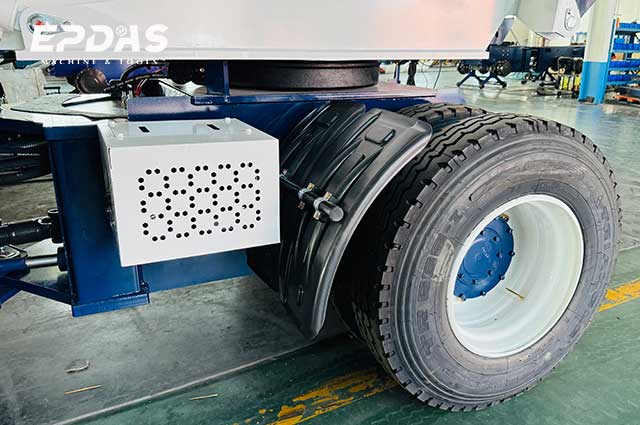
High-quality hydraulic components and Q345 manganese steel frame are used for stable performance. The inner wall of the mixing tank and the unloading chute are made of wear-resistant lining plates to reduce concrete wear; key parts are equipped with protective covers to prevent concrete residual damage equipment.
Safety and environmental protection advantages
Front and rear axle double-disk brake, fast braking response, safe and reliable; the cab is equipped with a protective device to ensure the safety of operators; the national third emission standard engine, exhaust emission meets the standard, reducing environmental pollution.
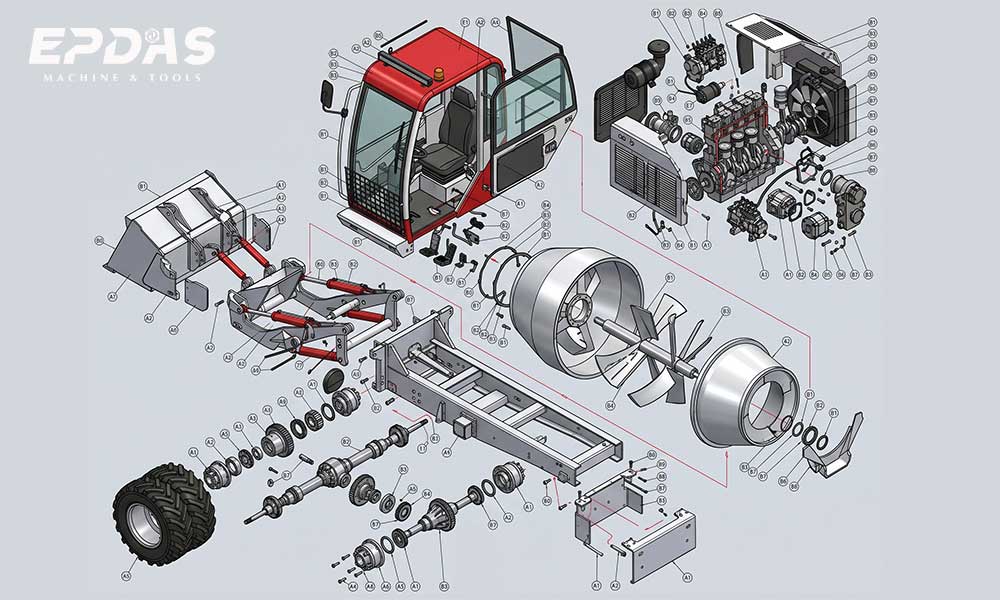
Structural Composition
Power and walking system
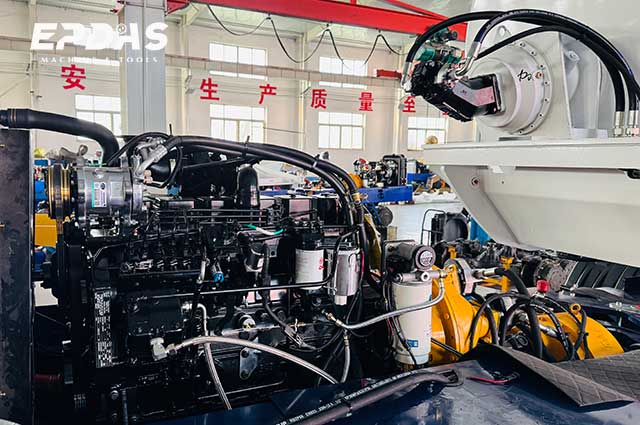
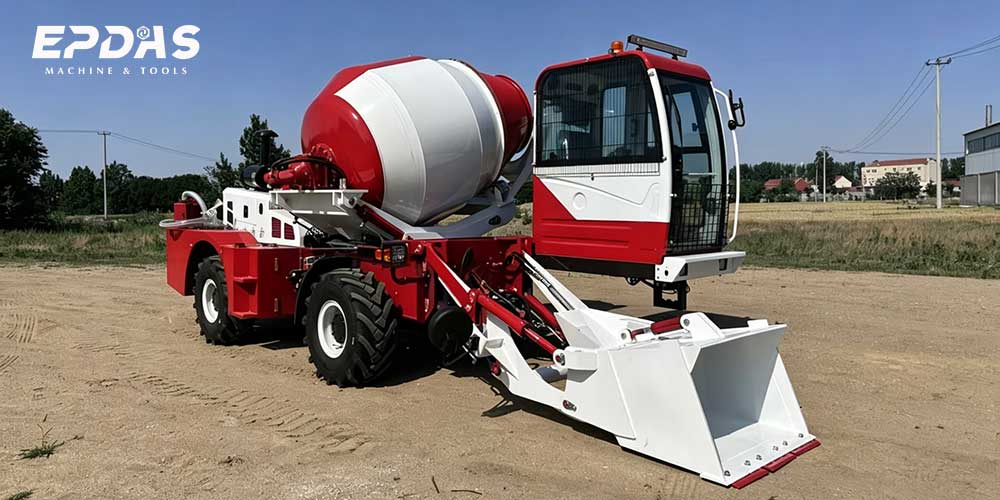
Equipped with Yuchai Guosan 4102 supercharged engine, with a rated power of 76kW and strong power; 4×4 four-wheel drive system, stable braking performance, safe and reliable; low and low-speed two-speed design, low-speed 0-25km/h, high-speed 0-30km/h, taking into account power and efficiency.
The loading and metering system
Front 0.4m³ hydraulic drive bucket, with vibrator and hydraulic gate, can quickly grab sand, gravel, cement and other raw materials; integrated automatic weighing device, can accurately measure the weight of raw materials in the bucket, and realize the automatic control of concrete ratio.
Water supply system
Hydraulic self-priming water pump, 24V self-priming centrifugal pump, can accurately control the amount of water, with a 550L large-capacity water tank to meet the water supply needs of long-term operation.
Stirring and unloading system
The mixing tank body is made of Q345 manganese steel, with uniform thickness, wear-resistant and corrosion resistance; the mixing tank supports horizontal 270° rotation, and the discharge port can be tilted vertically, with 150cm detachable lengthening chute and hydraulic vibration device to achieve high efficiency and residue-free unloading.
Chassis and control system
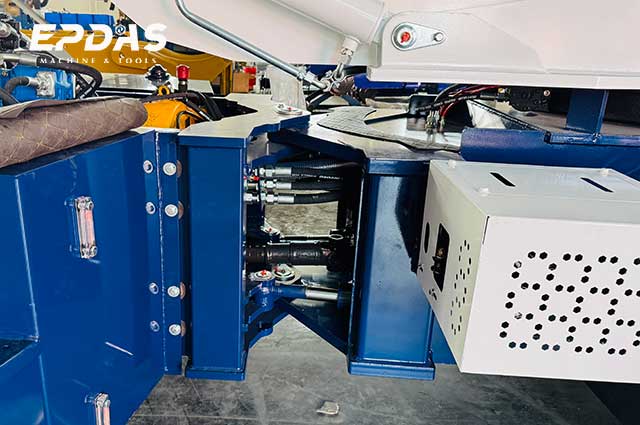
It adopts a hinged frame design, with a small turning radius and flexible steering; Q345 manganese steel frame with high strength; the cab is equipped with two hydraulic pilot operating rods to control the rotation and lifting of the bucket, arm and stirring tank respectively, and the operation is simple and intuitive.
Braking system
The front and rear axle double-disc brake, with hydraulic assistance braking, fast braking response, safety and reliability, to meet the braking needs of complex road conditions.
Hydraulic and electrical systems
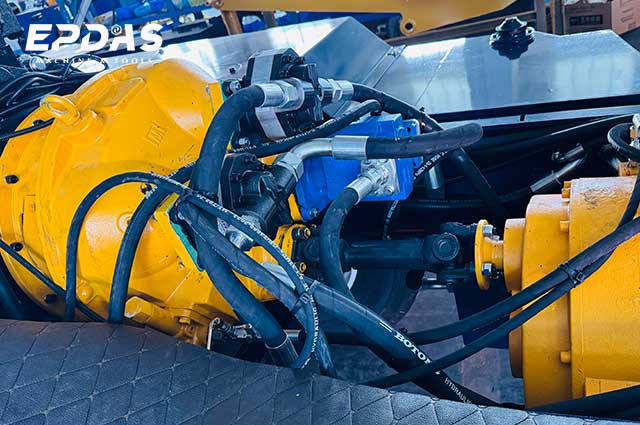
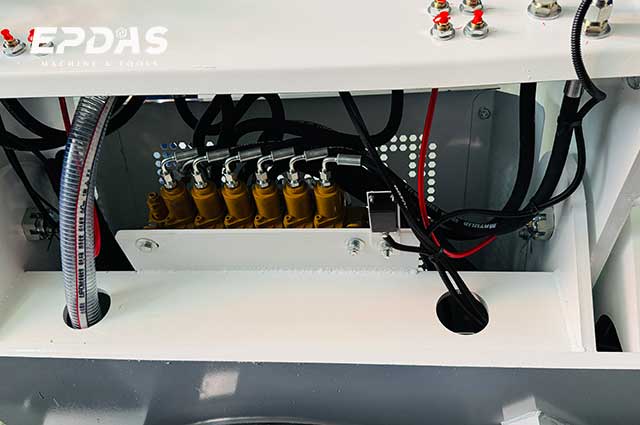
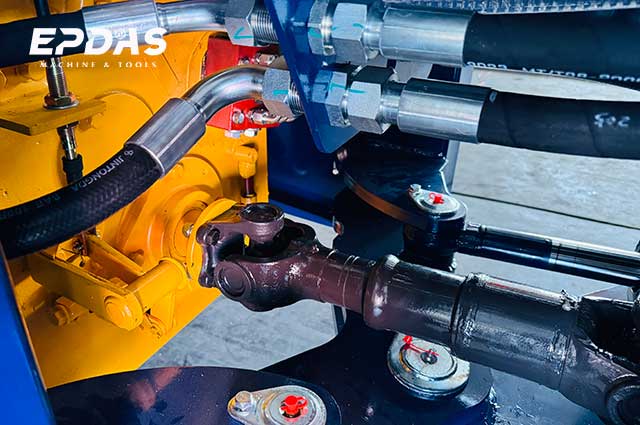
The self propelled concrete mixer truck hydraulic system adopts high-quality hydraulic components, with a volume of 90L of hydraulic oil tank, good heat dissipation performance, stable system pressure and low failure rate; 24V DC electrical system, clear line layout, waterproof and dustproof design, suitable for the complex environment of the construction site.
Repair and Maintenance
| Maintenance cycle |
Maintenance items |
| Every 50 hours / week |
1. Clean the air filter and check the engine intake system; 2. Check the hydraulic oil filter and clean the ventilation hole of the hydraulic oil tank; 3. Check the tightness of tire bolts and transmission shaft bolts; 4. Check the braking performance of the braking system and adjust the braking gap; 5. Add grease to the bucket pin shaft and the moving arm pin shaft. |
| Every 200 hours / month |
1. Replace the engine oil and oil filter; 2. Replace the hydraulic oil filter and check the quality of hydraulic oil; 3. Check the wear of the blades of the mixing tank and replace the lining plate if necessary; 4. Check the wear of the transmission shaft and gidirectional joint, and add grease; 5. Check the connection of the electrical line and clean up the dust of the line. |
| Every 500 hours / every quarter |
1. Replace the hydraulic oil and clean the hydraulic oil tank; 2. Replace the air filter and fuel filter; 3. Check the oil level and quality of the front and rear axle gear, and replace it if necessary; 4. Check the bolt fastening of the frame and the hinged part; 5. Calibrate the electronic metering system to ensure the accuracy of the ratio. |
| Every 1000 hours / year |
1. Comprehensively check the engine condition, adjust the valve gap, and check the fuel injector; 2. Check the performance of hydraulic pumps and hydraulic motors, and overhaul them if necessary; 3. Check the wear of the mixing tank bearing and add grease; 4. Check the hydraulic oil of the brake system and replace the brake fluid; 5. Remove rust and paint the whole vehicle to prevent rust. |
| Fault phenomenon |
Possible reasons |
Handling method |
| The mixing tank does not rotate |
1. Insufficient hydraulic oil or low pressure; 2. Hydraulic motor failure; 3. The concrete in the mixing tank is stuck. |
1. Check the hydraulic oil level and pressure, and replenish or replace the hydraulic oil; 2. Overhaul or replace the hydraulic motor; 3. After the shutdown, clean up the lump concrete in the tank and check the wear of the blades. |
| The material is weak |
1. Insufficient pressure in the hydraulic system; 2. The hydraulic cylinder of the bucket leaks; 3. The hydraulic oil filter is blocked |
1. Check the pressure of the hydraulic system and adjust the overflow valve; 2. Overhaul the hydraulic cylinder of the bucket and replace the seal; 3. Clean or replace the hydraulic oil filter |
| Unloading is not smooth |
1. The chute is blocked or the angle is inappropriate; 2. The proportion of concrete is unreasonable (the water-ash ratio is too low); 3. Failure of hydraulic vibration device |
1. Clean up the chute and adjust the angle of the chute; 2. Adjust the proportion of concrete and increase the amount of water appropriately; 3. Repair the hydraulic vibration device and replace the damaged parts |
| Insufficient engine power |
1. The air filter is blocked; 2. The fuel filter is blocked; 3. Fuel injector wear or carbon accumulation |
1. Clean up or replace the air filter; 2. Replace the fuel filter; 3. Overhaul the fuel injector to remove carbon accumulation |
Why Choose EPDAS – Three Key Factors
Direct supply from the original factory
EPDAS has a complete production and manufacturing system. The core components of the self propelled concrete mixer truck are produced by the original factory or selected from well-known brands. From raw material procurement, production and processing to factory testing, each process is strictly controlled. Each equipment needs to go through a number of tests such as no-load, full-load, continuous operation, etc. before leaving the factory to ensure stable performance.
Customized service
EPDAS provides personalized customized services, which can adjust the volume of the mixing tank according to customer needs, install protective devices, adapt to tires for special road conditions, etc. According to the emission standards of different regions, it can provide different versions of engines such as national three and national four to meet local construction standards; provide a variety of accessories options to adapt to customers Personalized construction needs of households.
Rich industry experience and professional technical support
EPDAS has been in the field of concrete mixing equipment for many years, and has a professional research and development and technical team to continuously optimize equipment performance according to the needs of small construction scenarios. After many iterative upgrades, the 1.8m3 self loading concrete mixer truck has solved the operating pain points of traditional equipment under complex road conditions. It can provide customers with construction plan consultation and provide integrated construction solutions.
Applications of Small Self-Loading Concrete Mixers
Rural self-built houses and small civil buildings
Rural self-built houses, rural residential transformation, small factory construction and other projects generally have problems such as narrow sites and poor road conditions. EP1.8Q self mix concrete truck has a small body and can drive directly into the narrow construction site and mix concrete on the spot, which can flexibly adapt to the construction rhythm of small civil buildings.
Rural roads and municipal small-scale projects
Rural highway hardening, municipal sidewalk laying, small bridge maintenance and other projects are usually decentralized and small-scale operations, and it is difficult for large mixers to enter the site. The concrete mixer truck can directly mix concrete on the roadside site and use it as it mixes, which adapts to the pouring needs of linear engineering such as roads and bridges.
Narrow sites and urban small-scale transformation projects
In urban old community transformation, basement construction, interior decoration concrete pouring, small commercial building construction and other scenarios, there are common problems of narrow construction space and large equipment cannot enter the site. The width of the 1.8Q body is only 2340mm, which can easily pass through the narrow passage.
Remote areas and outdoor emergency construction
Water conservancy projects in mountainous areas, road maintenance in remote areas, small-scale foundation projects in the field, emergency repair projects, etc., far away from large mixing stations and construction supporting facilities. EP 1.8m3 self loading concrete mixer truck has its own feeding, mixing and transportation functions, and can complete concrete supply independently without relying on external equipment.
Parameters of 1.8m³ Self-loading Concrete Mixer
| Item |
Specification |
| Model |
EP1.8Q |
| Model description |
Articulated chassis movable, Self loading, Mixing, Transporting |
| Productivity |
5 batches/hour, 8m³/hour, 18 rotation/minute |
| Drive |
4×4 |
| Steering |
Articulated steering |
| Engine |
Yuchai Engine (EURO-II) 4102 Turbocharged Engine 76 kW |
| Speed |
Low speed: 0-25 km/h, High speed: 0-30 km/h |
| Axle |
Q345 Manganese Steel Frame, Small-Wheel-Center Reduced-Speed Dual-Mount Brake Caliper, Heavy-Duty Mixer Truck Specialized Axle |
| Tyres |
20.5/70-16 steel wire tyres (Front 2 + Rear 2) |
| Drum |
Geometric volume 2.6m³, the best mixing volume 1.2-1.6m³ |
| Drum rotation and tilting |
The mixer drum can horizontally rotate 270°, and the discharge port can tilt vertically. |
| Chute |
Equipped 150cm detachable chute to increase discharge length |
| Bucket capacity |
0.4m³ with discharge vibrator, hydraulic gate |
| Operation handle |
Two hydraulic pilot joysticks control the bucket, lifting arm, drum 270° rotation/up/down |
| Water supply |
Hydraulic self-priming pump, 24V self-timing centrifugal pump |
| Water tank capacity |
550L |
| Diesel tank capacity |
90L |
| Hydraulic oil tank capacity |
90L |
| Weight and dimensions |
6300KG; 6700mm*2340mm*2700mm (L*W*H); Wheelbase: 2500mm; Wheel-track: 1800mm |
FAQS
Q1: What is the actual concrete production efficiency of EP1.8Q self loading mixer?
A: The rated production capacity of the mini self loading concrete mixer is 5 times/hour. The actual production efficiency is affected by the concrete ratio, raw material supply, construction site and other factors. It can complete 4-5 stirrings per hour, and the daily output can reach 60-70m³.
Q2: Can the equipment be used in sub-zero environments? What should I pay attention to?
A: The self load mixer can be used in a sub-zero environment, but anti-freeze measures need to be taken: replace antifreeze engine oil and antifreeze liquid, and add low-guling point diesel; after operation, put the water in the water tank, pump and water pipe to prevent freezing and cracking of the parts.
Q3: How to calibrate the electronic metering system of the equipment? Is the error rate high?
A: The electronic metering system has been calibrated before leaving the factory, and it can be calibrated regularly during use to ensure the accuracy of the ratio. Under normal use, the measurement error rate is ≤2%, which can meet the ratio requirements of concrete construction.
Q4: How to clean up the concrete residue in the mixing tank? Will it affect the next use?
A: After the operation, it is necessary to clean the mixing tank, bucket and chute immediately with a high-pressure water gun to remove the residual concrete; if it is not cleaned for a long time, the concrete clumping will lead to a decrease in mixing efficiency, so it is important to clean up in time after each operation.
Q8: Is it difficult to operate the equipment? How long will it take for a novice to learn?
A: The self loading cement mixer truck adopts hydraulic pilot operation, which is light and effort-saving control, and the operation interface is clear and intuitive. No professional mixer driver qualification is required. After 1-2 days of basic training, the operator can master the basic operation process.