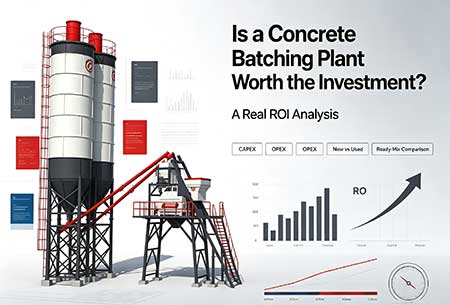
Research shows that concrete batching plants are capital-intensive projects, and their profitability is not a given but is subject to various factors. On the one hand, project returns depend on the actual local demand for concrete; on the other hand, they test investors’ ability to control costs throughout the entire project lifecycle, including initial capital investment and subsequent operating expenses. The actual utilization rate of equipment is a key factor affecting the return on investment (ROI); furthermore, factors such as raw material prices, labor costs, transportation radius, and equipment selection can further expand or compress profit margins. Before making an investment decision, a comprehensive return analysis must be conducted to assess whether the project is a sound investment.
In recent years, infrastructure renewal initiatives in the United States and the ongoing development of large-scale infrastructure projects in Southeast Asia and the Middle East have driven robust demand for ready-mix concrete in roads, bridges, airports, ports, and industrial parks. The production of precast components—such as precast beams, precast pipe piles, and prefabricated walls—requires a stable and independently controlled concrete supply; therefore, on-site concrete batching plants have become standard equipment at component manufacturing facilities.
Population size and the level of infrastructure activity determine the baseline demand and also influence the number of concrete batching plants in a region as well as their capacity utilization rates: if there is significant excess capacity, caution should be exercised when entering the market. The economic radius for concrete transportation is typically 50 kilometers; beyond this range, transportation costs rise significantly, and this is precisely where opportunities lie for locally owned concrete batching plants
.
Infrastructure Construction and Site Costs: Fixed concrete plants typically require civil engineering work such as concrete foundations, platforms, and retaining walls. Additionally, sufficient space must be set aside for stockpiling aggregates and cement, as well as for parking concrete mixer trucks. Therefore, costs for site leasing or purchase, site grading, and foundation construction are essential. These costs are significantly influenced by local land prices and civil engineering costs, ranging from several hundred thousand to several million yuan. While prefabricated batching plants (such as container-type or semi-trailer-type) can save a significant portion of the foundation construction costs, the purchase cost of the equipment itself is relatively high.
Installation and Commissioning Costs: After the equipment is purchased, professional personnel must perform on-site installation and commissioning. Based on experience, installation and commissioning costs typically amount to 5% to 15% of the equipment cost; this single expense alone can range from tens of thousands to over 100,000 yuan. Additional expenses at this stage may include transportation costs, customs duties (for imported equipment), and staff travel expenses.
Working Capital and Other Expenses: Investing in a concrete batching plant also requires a certain amount of working capital to cover raw material procurement, utility bills, and initial payroll. It is generally recommended to set aside several hundred thousand to several million RMB to sustain production and operations. Additionally, investments in environmental protection facilities (such as dust removal and wastewater treatment), office facilities, and safety equipment must be taken into account.
Although purchasing ready-mixed concrete from external suppliers can avoid a large amount of early capital expenditure (CapEx), land approval and environmental permit, in the long run, this will bring significant cost premiums and supply chain risks. Because the purchase price includes the profits of ready-mixed concrete plants, the price increases of intermediaries and the risks of long-distance transportation, the average market price of door-to-door concrete is usually between 120 and 200 US dollars per cubic meter (about 400 to 600 yuan per cubic meter). In addition, the procurement of concrete is subject to the supplier’s production plan and traffic conditions, which is likely to lead to “material shortage” at the construction site or project failure due to premature solidification.
In contrast, by building their own concrete batching plants, enterprises can greatly reduce the actual production cost per cubic meter to 70–90 USD/m³ (equivalent to 200–350 yuan/m³). This means that for every cubic meter of concrete produced, enterprises can directly save a marginal cost of $50–110/m³. For large and medium-sized projects with an annual consumption of tens of thousands to hundreds of thousands of cubic meters, this significant reduction in the cost per cubic meter can recover the investment of the mixing station in a very short time, thus bringing significant competitive advantages and cash flow returns.
Many investors are attracted by the quotation of “30% 50% cheaper” of second-hand equipment. However, from the full investment cycle of 35 years, the combined cost of second-hand equipment is often higher than that of brand-new equipment. The initial purchase quotation of the second-hand batching plant is low, and the short-term capital pressure is small. The delivery cycle is short and can be put into production quickly. But at the same time, we should also see the hidden costs and risks of second-hand batching plants.
Equipment wear leads to high failure rate; the batching host, weighing system and screw conveyor are worn for a long time, and the risk of failure and downtime is high. The loss of project delay caused by a shutdown may far exceed the difference in equipment price saved.
Parts are difficult to obtain and the maintenance cycle is long; the parts of old models are often discontinued and need to be customized, with high procurement costs and long waiting time.
Environmental protection is likely to not meet the standard; it is difficult for old equipment to meet the current dust and wastewater discharge standards, and it needs to be greatly renovated, and may even face shutdown.
There is no quality guarantee and technical support from the original factory; there is a lack of manufacturer’s installation and debugging, operation training and after-sales response, and all problems in the later stage need to be solved by themselves.
The real state of the equipment is not transparent; the parameters of the nameplate do not represent the actual production capacity, the hidden damage is difficult to find before purchase, and the actual output may be much lower than the design value.
The residual value of assets is low; the depreciation rate of second-hand equipment is faster when it is transferred again, and the residual value recovery rate is much lower than that of brand-new equipment.
Two. Compliance and worry-free: The new equipment adapts to the current environmental protection standards to avoid the risk of compliance transformation investment and fines.
Six The residual value and service life are better: the whole life cycle is longer, and the residual value is higher.
The general formula for calculating the return on investment (ROI) is:
ROI = (Annual net savings ÷ total investment cost) × 100%
Among them, the annual net savings income is “annual savings cost – annual operating expenses”. If you only compare the difference with the purchase of premix, it will be simplified to the annual savings. ROI can measure the rate of return of investment, and the higher the value, the more considerable the return on investment.
The formula for this period is:
Back to the current period (year) = total investment cost ÷ annual net savings
The indicator shows how many years it will take to offset the initial investment through savings. Under normal circumstances, the 3-5-year return is considered a reasonable interval. When the demand is unstable or the project time is short, the cost may not be fully recovered.
| Dimension | Evaluation Focus | Impact Mechanism on ROI |
| 1. Total Investment Scale | Initial setup and equipment acquisition costs | Higher upfront costs require greater overall savings to achieve the same ROI. Lower initial investment models yield a higher ROI for identical demand. |
| 2. Annual Demand Volume | Planned annual consumption and production volume | Greater demand increases economies of scale, maximizing annual cost savings, shortening payback periods, and boosting ROI. |
| 3. Equipment Utilization | Capacity release and operational dispatch efficiency | Maximizing capacity utilization is critical. Idle equipment or low dispatch/logistics efficiency reduces actual output, dragging down ROI. |
| 4. Raw Material & Energy Prices | Costs of cement, aggregates, electricity, and fuel | Price hikes in materials or energy increase on-site production costs and shrink overall savings, directly reducing ROI. |
| 5. Transportation Distance | Hauling distances and freight costs of ready-mix concrete | Longer external transit distances increase commercial concrete costs, making on-site batching save more money and driving up ROI. |
| 6. Labor Costs & Automation | Regional wage levels and level of system automation | High local wages increase overall batching costs. Higher automation cuts labor requirements, lowering payroll expenses and lifting ROI. |
| 7. Depreciation & Market Fluctuations | Accounting depreciation schedules and market price trends | Depreciation impacts net profit calculations. Rising market prices for ready-mix concrete enhance ROI, while falling prices discount returns. |
Reasonable selection and matching production capacity; choose the appropriate capacity after evaluating the annual demand, avoid blindly pursuing large equipment, so as to reduce the initial investment. Small and medium-sized enterprises can consider mobile or modular batching plants to reduce infrastructure construction costs.
Improve the utilization rate of equipment; you can share equipment with other projects, schedule across projects, or take external concrete orders to ensure that the equipment operates all year round.
Reduce the cost of raw materials; reduce the cost of cement, sand and gravel procurement through bulk procurement or nearby sites. For example, buy aggregates by yourself or cooperate with mines to reduce the price increase of intermediaries.
Optimize production efficiency; maintain equipment regularly, arrange production scheduling reasonably, and use automated systems to reduce waste. Aimix and other manufacturers mentioned that modern batching plants can reduce material loss and increase output through intelligent control and high-efficiency mixers.
Reduce logistics costs; choose a site near the construction site to reduce the transportation of finished concrete; use skid-mounted/integrated equipment to reduce the cost of equipment transportation.
Technology upgrade; according to production needs, reasonably equipped with automatic control, remote monitoring and other functions to reduce labor costs and human errors, and improve quality consistency.
| Equipment Type | Representative Models / Theoretical Capacity | Key Features & Applications | Reference Price Range (USD) |
| plantary Skip-Hoist Concrete Plant | HZS25 – HZS200
(25–200 m³/h) |
Uses a skip hoist for material feeding; features a compact footprint and structure; suitable for small-to-medium projects and sites with space constraints. | $25,000 – $50,000 |
| plantary Belt-Conveyor Concrete Plant | HZS60 – HZS240
(60–240 m³/h) |
Uses an inclined belt conveyor for continuous feeding; offers high production efficiency and precise batching; the preferred choice for standard commercial ready-mix plants. | $50,000 – $210,000+ |
| Mobile Concrete Plant | YHZS25 – YHZS90
(25–90 m³/h) |
Features a towable chassis and modular components; requires no heavy foundation; allows for rapid installation and dismantling; suitable for linear projects such as highways and wind farms. | $35,000 – $120,000 |
| Foundation-Free Concrete Plant | FHZS25 – FHZS75
(25–75 m³/h) |
Can be installed on pre-hardened ground, significantly reducing civil engineering costs; suitable for tight urban spaces and short-term rental projects. | $28,000 – $65,000 |
| Containerized Concrete Plant | HZS-C60 – HZS-C180
(60–180 m³/h) |
Fully enclosed in standard shipping containers; offers high structural strength and excellent dust control, sound insulation, and extreme cold resistance. | $60,000 – $180,000+ |
To ensure that the investment in a concrete plant is scientifically sound and rational, it is recommended that enterprises follow these steps.
Two. Statistics of current procurement costs: account for the current average price of concrete purchased from external suppliers (including transportation fees), as well as the price trend of materials in recent years.
Six Determine the appropriate production capacity: combine the annual demand and daily peak demand, and choose the production capacity specifications that will not be excessively idle for the duration of use and can meet the peak demand. Modular or mobile devices can be selected for future expansion or transfer.
Seven Budget and get quotation: contact reliable batching plant suppliers (such as Aimix, Sanyi, CementPlants, etc.) to request comprehensive quotations including equipment, installation, technical support, etc.
Q: How long does it take for the concrete batching plant to return the cost?
Answer: Under normal circumstances, if the demand for concrete in the project is large and the price difference is obvious, it will be about 3-5 years. It depends on the investment amount and the annual savings. For example, a project that saves two to three million yuan every year invests tens of thousands of yuan, which can generally be covered in three to five years. If the demand for the project is small or the price gap is small, the return period will be significantly extended (more than 10 years or even impossible to return the cost).
Q: Is it necessarily cheaper to build a self-batching plant than to buy a pre-batching plant?
Answer: Not necessarily. The key lies in the scale of demand and the cost of transportation. If the supplier is close, the price is low, and the construction volume is small, the outside purchase is more flexible; but if the demand is large and the transportation cost is high, self-made is usually more economical. When comparing, the comprehensive cost (raw materials + operation + transportation) should be calculated before making a decision.
Q: What is the typical ROI of the batching plant?
Answer: ROI can be very high under efficient utilization. Cases have shown that ROI can exceed 40% in large-scale infrastructure projects. General business reports believe that 3-5 years of return means that the annual ROI is between 20–33% (not considering interest). However, the specific ROI depends on many factors, such as utilization rate, material cost, sales price, etc.
Q: What factors will affect the profitability of the batching plant?
Answer: The main factors include concrete demand and utilization rate, raw material and energy prices, equipment depreciation years, local labor costs, premixed market prices and transportation costs, etc. For example, insufficient demand, rising raw material prices, falling transportation costs, etc. may reduce profits. It is generally recommended that enterprises try to control non-material costs (such as optimizing ingredients and improving automation) and make full use of equipment to improve profits.
Q: Which is better, a mobile batching plant or a stationary concrete batching plant?
Answer: Mobile (towing/container) installation is fast, suitable for projects with short cycles and frequent transfer; the initial plant construction cost is low but the unit price of the equipment is slightly high; it can reduce the foundation and installation costs. The fixed type is suitable for long-term large-production projects. The equipment automation is higher, and the hourly production capacity may be greater. It needs to be selected according to the nature of the project.
Whether it is worth investing in concrete batching plant depends on the economy. When the demand is large and the existing concrete cost is high, the self-built batching plant can quickly recover the investment by saving costs and improving efficiency; on the contrary, it should be cautious. The analysis of this article shows that the key factors affecting ROI include annual demand, capacity utilization, material and transportation costs, equipment investment, etc.
EPDAS provides a variety of mobile and fixed concrete plants, which can customize capacity and configuration on demand, and supports free ROI assessment services. Please click the link below immediately to get the investment return case report and customized plan of the batching plant, so that we can help you reduce construction costs and increase profits!