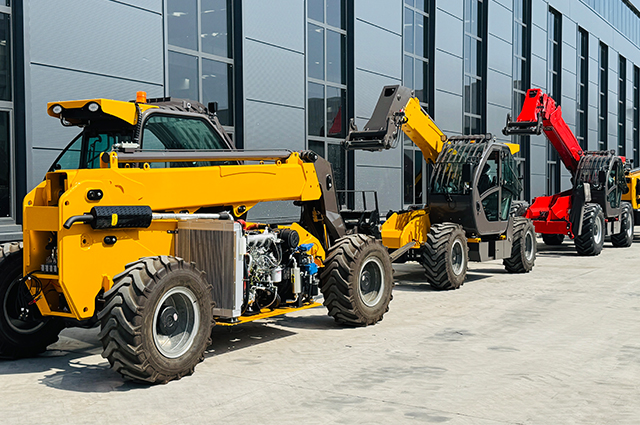
What is Telehandler?
The birth of the telescopic forklift mainly solves the technical problem of automatic fork leveling. The traditional forklift adjust the lifting height by lifting the vertical door frame, and the fork-plane remains horizontal during the lifting process and will not change angle. But the telescopic handler’s fork-height is adjusted by the telescopic arm changing their angle and length, and the fork-plane angle is also changed by the telescopic arm’s angle changing.

 Application of Telehandlers
Construction Sites
Unloading and short-distance transportation of construction materials, placing construction materials directly at the work site; or feeding materials to cranes and tower cranes; Transportation and site cleanup of various materials;
Loading and unloading of block, strip, and irregularly shaped building materials using forks and lifting attachments;
Loading and unloading of loose materials using a bucket and leveling the ground;
Using aerial work platforms for high-altitude installations; using glass suction cups for installing curtain walls; and so on.
Logistics and Warehousing Industry
Moving and transporting various materials on rough ground is made easier by the telescopic handler’s powerful traction, high ground clearance and stable four-wheel drive system, ensuring reliable handling across uneven, muddy or debris-covered surfaces.
Agriculture and Livestock Industry
Moving feed bales within the pasture, cutting and feeding feed, cleaning up manure;
Packaging and moving grass, straw, and other materials.
Terminal and Container Sites
At ports or container handling yards, telehandlers can handle high-level cargo handling and loading/unloading tasks. EPDAS telescopic forklifts offer multiple tonnage and boom length configurations, enabling customers to customize equipment based on construction height, cargo type, and operational frequency.

 How to Drive and Operate the Telehandler?
Operational Controls for Telehandlers
Operating a telehandler requires mastering the core. When starting, in the driving selection, three modes can be switched and selected through the control lever on the left side of the steering wheel. All-wheel steering enhances maneuverability, two-wheel steering ensures stable driving, and crab steering makes it convenient to move horizontally in narrow areas.
Replacement of Attachments for Telehandlers
The right joystick controls the boom’s lifting, lowering, and telescoping movements. Pull it backward to raise the boom, push forward to lower it, and gently push the upper extension rod to extend the boom to its maximum reach. When installing or replacing attachments, first precisely align the adapter at the boom’s end with the attachment. Slowly bring them together, then use the joystick to control the locking mechanism and complete the replacement.
 Main System of Telehandlers
Diesel Engine
YUNEI/YUCHAI EU-2 as standard;
WEICHAI/CUMMINS/YANMAR/PERKINS/FIAT/KOHLER as option;
EU-3/4/5/EPA4 as option.
Hydraulic System
Open type (Chinese brand) as standard;
Closed static hydraulic system (DANFOSS) as option.
Telescopic Arm
Vehicle body is forged from 355 manganese plate, and the telescopic arm is made of BS1000 special steel.
Chassis & Axles
LIUFENG chassis/axles as standard;
TOPUNON/TRANSPOWER wet brake axles as option.
Driven Cab
Include air suspension adjustable seats, air conditioner, hydraulic power steering, and audio-visual entertainment system;
Hydraulic pilot-operated control handle as standard;
Load-sensitive valve electro-hydraulic proportional control handle as option.

 EPDAS Telehandlers Parameter
Light type: Lifting height of 5-7 meters, load capacity of 3-4 tons, 2 telescopic arms, 4-wheel drive, three steering modes (two-wheel steering, four-wheel steering, crab steering), no auxiliary support legs, no body balance, diesel drive.
Heavy type: Lifting height 7-18 meters, load capacity 5-21 tons, 2-4 section telescopic arm, 4-wheel drive, three steering modes (two-wheel steering, four-wheel steering, crab steering), with auxiliary support legs, with body balance, diesel drive.
| Model | T3007 | T3507 | T5010 | T5014 | T5017 | T4018 |
| Lifting height | Max. 7000mm | Max. 7000mm | Max. 9800mm | Max. 13800mm | Max. 16550mm | Max. 17550mm |
| Load | Max. 3000KG | Max. 3500KG | Max. 5000KG | Max. 5000KG | Max. 5000KG | Max. 4000KG |
| Engine Power | 76KW/106HP (Standard: YUNNEI) ● | 76KW/106HP (Standard: YUNNEI) ● | 91KW/122HP (Standard: YUCHAI) ● | 91KW/122HP (Standard: YUCHAI) ● | 97KW/132HP (Standard: COMMINS) ● | 97KW/132HP (Standard: COMMINS) ● |
| Engine Power | 74KW/100HP (OPTION: CUMMINS) ○ | 74KW/100HP (OPTION: CUMMINS) ○ | EURO II | EURO II | EURO III | EURO III |
| Engine Power | 61.3KW/83HP (OPTION: YANMAR) ○ | 61.3KW/83HP (OPTION: YANMAR) ○ | 400Nm @ 1400rpm | 400Nm @ 1400rpm | 600Nm @ 1500rpm | 600Nm @ 1500rpm |
| Moment limiter | ○ | ● | 2 Sections | 3 Sections | 4 Sections | 4 Sections |
| Driving Cab | Junior type ● | Junior type ○ | 4500mm | 7000mm | 9600mm | 9600mm |
| Tires | Pneumatic-tires (16/70-20) ● | Pneumatic-tires (16/70-20) ● | Steel-wheel for Loading-container ● | Steel-wheel for Loading-container ● | Steel-wheel for Loading-container ● | Steel-wheel for Loading-container ● |
| Max. Grade-ability | 25° | 25° | Auto Air-cut brake ● | Auto Air-cut brake ● | Auto Air-cut brake ● | Auto Air-cut brake ● |
| Travelling speed | 28km/hr | 28km/hr | 30km/hr | 30km/hr | 25km/hr | 25km/hr |
| Dimensions | 4650*2150*2300mm | 4730*2390*2485mm | 6400*2400*2550mm | 6430*2400*2550mm | 6500*2400*2790mm | 6500*2400*2790mm |
| Self-leveling Forks | 1220*150*50mm (L*W*T) ● | 1220*150*50mm (L*W*T) ● | 1220*125*50mm (L*W*T) ● | 1220*125*50mm (L*W*T) ● | 1220*150*50mm (L*W*T) ● | 1220*150*50mm (L*W*T) ● |
 Telehandler Attachments Options
Which Attachments Can be Installed on Telehandlers?
The telescopic boom forklifts of EPDAS are equipped with over ten types of attachments such as standard forks, buckets (toothed and smooth), grippers, hooks, platforms, soft clamps, and sweepers. Moreover, they can also customize special attachments according to the construction requirements of customers.
All these attachments can be replaced through the end conversion head of the boom. After the attachments are replaced, one telehandler can undertake multiple tasks, greatly improving the equipment utilization rate and work efficiency.

 Telehandlers Packing & Delivery