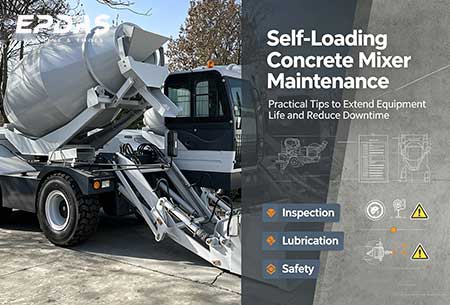
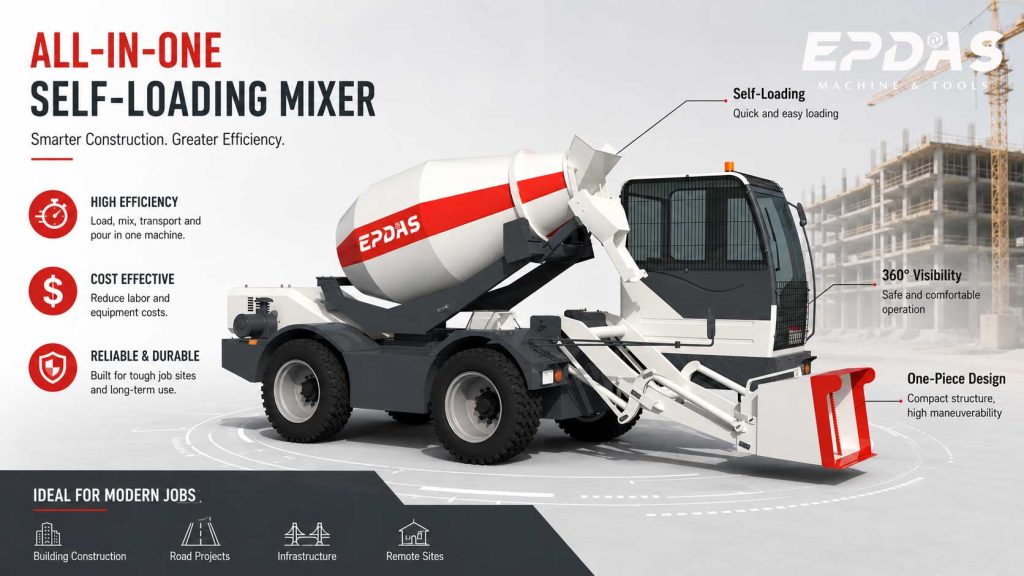
The self-loading concrete mixer integrates the four functions of automatic loading, mixing, transportation and unloading. There is no need for a supporting mixing plant, and it can be operated by one person, which greatly saves labor costs and equipment investment costs, and completely solves the pain points such as poor mobility, cumbersome construction and lag of the traditional mixing mode. However, with the increasing number of equipment categories in the market, two major mainstream models have appeared in the industry, the traditional Articulated Self-Loading Mixer and the New Generation Integrated Self-Loading Mixer. Loading Mixer).
For the vast majority of engineering contractors, equipment buyers and leasing merchants, the problem of model selection follows: the two equipments are similar in appearance and have similar basic functions, but there is an obvious price gap. Which one is the best choice for modern construction engineering? Many buyers blindly choose hinged models because they are greedy for low prices. In the end, they face a series of problems such as serious body shaking, poor concrete mixing quality, high-frequency failure shutdown, high maintenance costs, and short equipment service life, which increases the overall construction cost and delays the project construction period.
The global market of the self-stacking mixer industry is experiencing rapid growth. Behind this growth trend is the superposition of multiple favorable factors. First of all, the continuous growth of global concrete demand, the acceleration of urbanization and the intensive promotion of infrastructure construction have directly driven the market demand for concrete production equipment. The second is the dual demand for construction efficiency and cost control. The “one machine for multiple uses” characteristics of self-loading mixers enable contractors to greatly reduce manpower and equipment investment, which is one of the core driving forces for market expansion. There are also technological upgrading and new energy transformation. Electrification, automation, Internet of Things integration and other new technologies are reshaping the industry pattern, injecting new growth momentum into the market.
In the current self-topping mixer market, two mainstream chassis technology routes coexist. All functional components of the integrated chassis are highly integrated on a single frame, with a compact structure and strong rigidity, and the body shape and center of gravity distribution are stable when steering. This design pursues safety first and stability first, which represents the high-quality route of self- loading mixer. The hinged chassis body is divided into two sections, the front and rear, and the middle is connected by a hinge pin, which is similar to the hinge card design. Its advantage lies in its extreme flexibility under extreme working conditions, but at the cost of a significant decrease in stability and security. Because of its simple structure and low manufacturing cost, it has become a low-cost compromise plan for some low-budget projects.
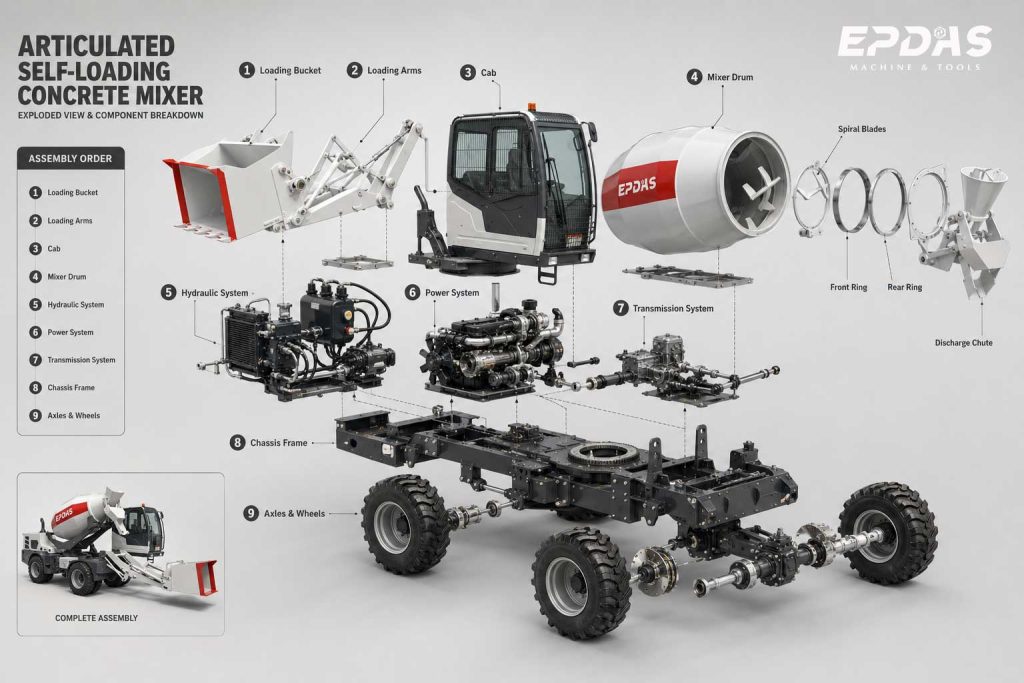
The articulated self-loading mixer is a classic model in the early days of the industry. In order to reduce production and manufacturing costs and adapt to the demand of the low-end market, the front and rear split frame hinged splicing structure is adopted. The whole vehicle is divided into two parts: the front body (cab, power system, front wheel) and the rear body (mixing cylinder, hopper, rear wheel). In the middle, it is spliced and combined by hinged hinges, bearings and sealing connectors.
The original intention of the core design of this structure is to reduce the production threshold and the selling price of compression equipment. The advantage is that the entry price is extremely low, which is suitable for short-term temporary construction and simple operation of leveling the site. However, from the perspective of durability, stability and long-term use of engineering equipment, the hinged splicing structure has congenital design defects: the body is not an overall rigid structure, and there are moving gaps in the front and rear bodies, which belongs to the flexible connection mode, which also bury the core hidden dangers for subsequent shaking, failure, wear and safety hazards.
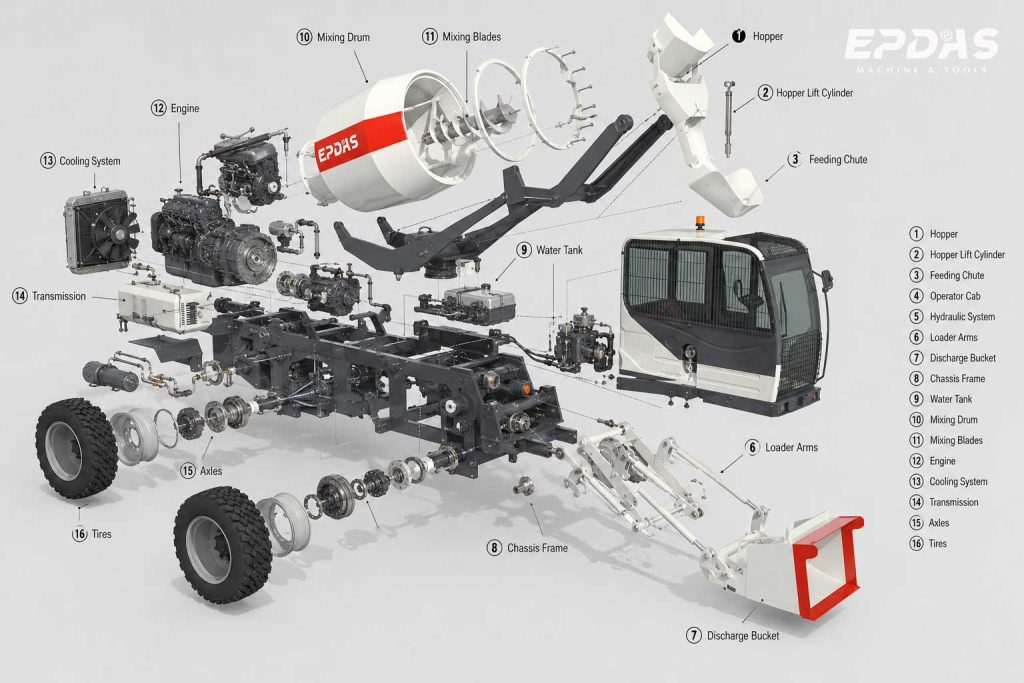
The Integrated self-loading mixer is a new generation of engineering machinery for the iterative upgrading of the pain points of hinged equipment. The core breakthrough lies in the overall welding rigid frame design. The whole vehicle adopts an integrated molding process, with no segmentation, no hinges, no splicing gaps. The cab, powertrain, mixing system and walking system are completely integrated on the same overall frame, and the rigidity, integrity and anti-deformation ability of the body are improved.
The design abandons all the active connection and damage structures of hinged equipment, and solves the industry pain points of shaking, wear, loosening and frequent failure of split frames from the root cause. It fully adapts to the core requirements of modern engineering for equipment stability, safety, long-term and high-precision construction. It is also the current high-end engineering at home and abroad, long The mainstream selection of construction projects and equipment leasing industries.
| Contrast dimension | Integrated Chassis | Articulated Chassis |
| Structural characteristics | Integrated frame structure, high overall rigidity and uniform load distribution | Multi-stage frame, connected by a hinged pin in the middle |
| Stability | When driving and steering at full load, the body posture is stable and extremely high. | Uneven distribution of heavy-load download load, low |
| Safety performance | The risk of overturning is extremely low, which can effectively cope with complex road fluctuations. | When turning at a full load, it is easy to overturn due to the ups and downs of the road surface, and the risk is high. |
| Flexibility of turning | Good (with rear-wheel steering or all-wheel steering) | Excellent (small turning radius under extreme working conditions), but unstable |
| Manufacturing cost | It is relatively high and requires advanced structural manufacturing technology. | Low, the structural materials and processes are relatively simple. |
| Maintenance needs | Routine maintenance, no need for additional handling of the hinging structure | The hinge pin needs to be lubricated regularly, and there are many fault points. |
The articulated self-loading mixer is limited by the split hinge structure. The front and rear bodies rely on the flexible connection of the hinge, and there are innate connection gaps that cannot be eliminated. When the flat road surface is low-speed no-load driving, the difference in equipment is not obvious, but after entering the real construction scene, the short board is completely exposed: there are many muddy, bumps, steep slopes and curved road conditions in modern construction sites. When the equipment is heavy-loaded to transport concrete, the gap between the hinged hinges will continue to amplify, and the car body will obviously shake left and right, and the front and rear errors. Position, the side tilt is large when turning, and the center of gravity is seriously shifted when climbing. After long-term operation, the hinge and bearing continue to wear out, the gap will be further increased, and the problem of body shaking will continue to be aggravated, which not only affects the operation experience, but also has great safety hazards of rollover and sideways, which is one of the main causes of safety accidents on field construction sites.
The integrated self-loading mixer relies on the overall rigid frame. The whole vehicle has no splicing and no movement gap. The body center of gravity is integrated and the force is uniform. Whether it is empty or heavy-load driving, or climbing hills, turning, and crossing bumpy and muddy roads, the car body has always been in a stable state, without shaking, tilting or center of gravity shifting. The high rigidity characteristics of the overall frame can effectively resist road impact and heavy load pressure. The stability under extreme working conditions far exceeds that of the hinged model, which greatly reduces the probability of safety accidents such as rollover and out of control. It fully ensures the personal safety of construction personnel and the safety of the project construction, and fully adapts to the safety operation requirements of modern complex construction sites.
The continuous shaking of the body during the operation of the hinged mixer truck will be directly transmitted to the mixing cylinder, resulting in the shaking of the mixing cylinder, the fluctuation of the speed, and the displacement of the stirring trajectory. In the process of concrete mixing, the ratio of sand, stone, cement and water cannot be evenly integrated, which is very prone to problems such as concrete separation, uneven dry and wet, aggregate precipitation and so on. After the completion of pouring, the walls and road surface are prone to quality problems such as hollow drums, cracking, and insufficient strength. If it is mild, it needs to be partially repaired and rectified, and if it is heavy, it needs to be reworked as a whole, which not only wastes raw materials and delays the construction period, but also affects the pass rate of project acceptance, causing unnecessary economic losses to the construction party, and completely cannot meet the requirements of municipal engineering, Construction requirements for commercial buildings and high-standard infrastructure.
The whole structure of the integrated self-loading concrete mixer truck is stable, the mixing cylinder is firmly fixed, the operation is jitter-free, the stirring speed is constant, and the stirring trajectory is standard, and the automatic mixing operation can be completed strictly according to the preset ratio. Sand, gravel, cement and water are fully integrated, and the finished concrete product has high uniformity, stable consistency, and no separation and precipitation problem. The strength of the finished product meets the standard, and the molding effect is flat and beautiful. The refined mixing effect perfectly fits the high-standard construction specifications of modern construction projects, effectively eliminates the problem of rework rectification, and ensures that the project acceptance is passed at one time. It is especially suitable for the construction of high-quality and high-requirement formal engineering projects.
In the long run, the whole life cycle cost of equipment is much more valuable than the initial purchase price. The maintenance pain point of the hinged self- loading mixer is concentrated in the hinged connection part. The intermediate hinged pin needs regular oiling and lubrication to prevent wear, but in the high-load and dusty operating environment, the wear rate of these mechanical parts is extremely high. Once the hinging structure is loose or the gap exceeds the standard, it will lead to abnormal driving noise and abnormal operation, and if it is heavy, it will directly threaten the stability of the whole vehicle, which requires a lot of time and cost for overhaul.
With its simple structural design, the integrated self- loading mixer has greatly reduced the number of key connection nodes. Daily maintenance is mainly based on routine engine inspection and hydraulic system maintenance, and there is no need for additional treatment of complex mechanisms such as hingings. This strongly guarantees the attendance rate and reliability of the equipment, and significantly reduces the time cost and missed work losses caused by maintenance downtime.
The structure of the ringed mixer is complex, and the number of core consumable parts is large. The hinged hinges, connecting bearings, sealing gaskets, movable connectors and other components are in a state of vibration, friction and force for a long time, which is a high-frequency loss part. Frequent maintenance not only requires continuous investment in accessories and labor maintenance costs, but also causes long-term equipment downtime and delays the construction progress.
The integrated self-loading mixer has no hinged active connection structure. The whole machine structure is simple and compact and extremely rigid, which eliminates the high-frequency fault points of the hinged equipment from the root cause, and the number of consumable parts is reduced by more than 70%. During the operation of the equipment, there is no loosening, no abnormal wear, no potential for oil leakage, and the failure rate is greatly reduced. Only conventional oil and filter maintenance are needed in daily life. The maintenance cycle is greatly extended and the maintenance cost is greatly reduced. More importantly, the continuity of equipment construction is extremely strong, and there is almost no failure downtime, which can ensure the steady progress of the project construction period, completely solve the industry pain point of “continuous small failures and frequent large failures” of traditional mixers, and greatly reduce the long-term operating cost of equipment.
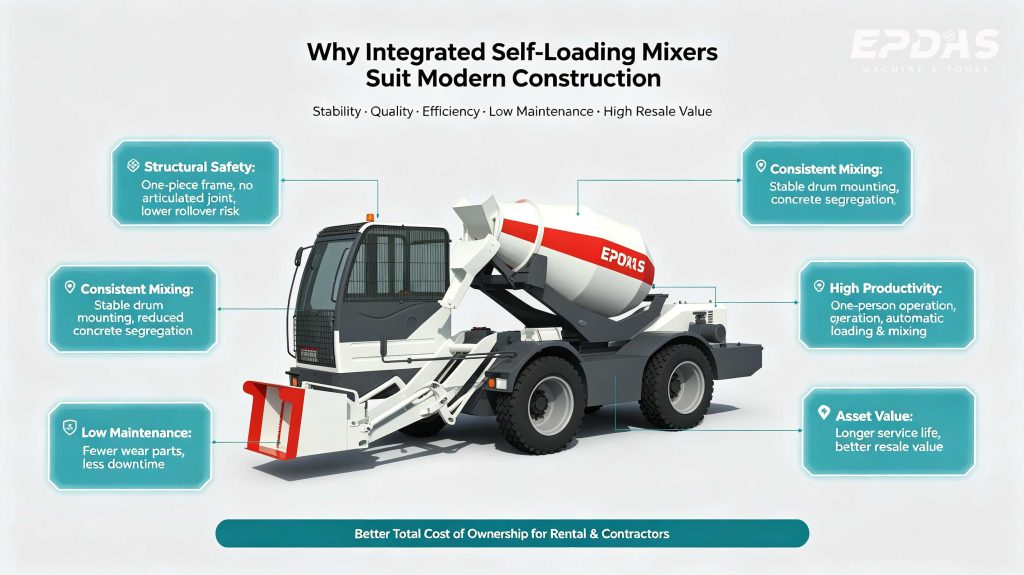
There is a fatal force defect in the split splicing structure of the hinged mixer. During heavy load operation, the force of the body is concentrated in the hinged connection part, and the force is extremely uneven. Under long-term bumps, vibrations and heavy loads, the connection part is prone to metal fatigue, frame deformation, weld cracking and other problems, and the overall performance of the equipment will be rapidly attenuated. Under normal working conditions, after 2-3 years of use, there will be problems such as increased shaking, frequent failure, and decreased operation performance. It will be basically scrapped in about 5 years, and the depreciation of equipment is extremely fast, and the cost-effectiveness of long-term reuse and leasing is extremely low.
The integral frame of the self loading mixer is integrally molded, and the force of the whole car is evenly dispersed, without stress concentration points, and has strong impact resistance, fatigue resistance and deformation resistance. Whether it is long-term high-frequency heavy-load operation or continuous construction under complex working conditions, the frame will not have problems such as deformation, cracking, loosening, etc., and the equipment performance is stable for a long time and there is no obvious attenuation. According to the actual measurement data, the effective service life of the integrated self-loading concrete mixer is more than 1.8 times that of the hinged model. The value retention rate of the equipment is higher, and the profit cycle of long-term self-use and external leasing is longer. It can maximize the return on investment of equipment. It is the best choice for long-term engineering operations and equipment leasing companies.
Complex infrastructure projects in the field. Mountain roads, rural dirt roads, muddy wastelands, remote no infrastructure construction sites, such scenes have poor road conditions, no fixed mixing stations, and poor construction environment. The requirements for equipment stability and durability are extremely high. Integral self-loading concrete mixer can be perfectly adapted and are not afraid of complex working conditions.
High-standard municipal and commercial construction engineering. Municipal road surface hardening, community supporting projects, shop factory construction and other projects have strict requirements for concrete quality and project acceptance standards. All-in-one equipment has high mixing accuracy and stable finished product quality, which can effectively ensure that the project acceptance meets the standard.
Long-term high-frequency operation and equipment rental scenarios. The long-term multi-project rotation construction of the engineering company, and the equipment leasing company put in bulk equipment. The core values the long life of the equipment, the few failures, the fast return on investment, the low operation and maintenance cost of all-in-one equipment, the long profit cycle, and the investment cost-effectiveness is extremely high.
Urgent engineering projects with tight construction schedule. The integrated self loading cement mixer has strong continuity of construction, no failure stoppage, and high operation efficiency, which can ensure the construction progress to the greatest extent and help the project be completed on time and ahead of schedule.
The release and implementation of a series of international safety standards such as ISO 6085:2023 have put forward stricter certification requirements for the safety of the whole machine of self- loading mixers. With the increasing punishment of safety accidents on construction sites by laws and regulations of various countries, the owner and the general contractor attach great importance to safety performance when selecting equipment. Under this trend, the survival space of hinged chassis in the mainstream market is gradually being compressed.
The global self-fed loading mixer market is accelerating its transformation in the direction of electrification and hybridization. The internal combustion engine model still dominates the market, but the electric mixer has attracted more and more attention because of its significant advantages in sustainable development and emission reduction; the hybrid model, as a growing subdivision, integrates the advantages of both. In the process of electrification, the simple structure of the integrated chassis, high efficiency of energy transmission, lightweighting of the whole vehicle and other characteristics are naturally more suitable for the layout requirements of the electric power system. Leading manufacturers in the industry have been actively laying out in this direction. The new electric self-filling mixer launched by Fiori Group in May 2025 is a compact integrated design product tailored for urban construction sites.
Judging from the product layout of the world’s leading manufacturers, the integrated technology route is becoming a recognized development direction. SANY Group, XCMG, Volvo, Zoomlion, Liebherr, CASE Construction and other industry giants are continuing to increase their R&D investment and technological innovation in integrated self-inputt mixers. XCMG acquired a European self-instaring mixer manufacturer in October 2024 to accelerate the expansion of its global product portfolio. This collective choice of the head manufacturers is itself a strong endorsement of the long-term value of the integration route.
With the increasingly fierce competition in the market, more and more contractors have begun to get rid of the short-sighted thinking of “only looking at the purchase price” and turn to the operational efficiency, maintenance cost and total cost of ownership of equipment. With its comprehensive advantages in attendance rate, durability and residual value rate, the all-in-one self-loading concrete mixer has a significant advantage in the trend of upgrading the business philosophy.
Q1: The all-in-one self-loading concrete mixer truck is more expensive than the hinged one. Why is it more worth buying?
A1: The price difference between the two is a short-term procurement cost, while the operation and maintenance cost, downtime loss, rework cost and service life of the equipment are the long-term core costs. The initial purchase price of all-in-one equipment is slightly higher, but the failure rate is extremely low, the maintenance cost is low, there is no rework loss, and the service life is doubled. Based on the calculation of the 3-5-year use cycle, the overall cost is more than 30% lower than that of ringed equipment, and the construction efficiency is higher, the engineering quality is better, and the long-term cost-effectiveness far exceeds that of the hinged model.
Q2: Can the hinged mixer meet the needs of ordinary rural small-scale construction?
A2: It can be adapted to short-term, flat site and low-standard small temporary construction, but there are obvious hidden dangers. Even for small-scale projects, the road conditions in the countryside are mostly bumpy, the hinged equipment is prone to the risk of shaking and tilting, and long-term use of frequent failures, which delays the construction progress. If it is long-term rural infrastructure construction and mass engineering construction, all-in-one equipment is still recommended first, and the stability and long-term effectiveness are more guaranteed.
Q3: Will the maintenance of the all-in-one mixer be more difficult than that of the hinged one?
A3: No, it’s simpler. Hinged equipment has many consumable parts and complex structures, which requires frequent maintenance and replacement of accessories. The maintenance process is cumbersome and expensive. The all-in-one equipment has a simple structure, no movable and easy-to-wear structure. It only needs routine maintenance in daily life. The maintenance frequency is low, the operation is simple, and the loss of accessories is small. Zero basic operators can also complete the basic maintenance work.
Q4: How much higher is the construction efficiency of an all-in-one mixer than that of the ringed mixer?
A4: Comprehensive construction efficiency is improved by 20%-35%. On the one hand, the mobile integrated self-loading concrete mixer runs stably, does not need to slow down, and the transshipment cycle is shorter; on the other hand, the equipment is stopped without failure, does not require frequent maintenance, and the construction continuity is stronger. At the same time, the mixing quality is stable and there is no rework problem, which effectively saves rectification time, and the overall single-day construction capacity and project completion efficiency are greatly improved.
Q5: Can the all-in-one self-inpining mixer truck adapt to extremely narrow construction sites? Will the turning radius be too big?
A5: Hyundai’s one piece frame self-loading concrete mixer generally adopts all-wheel steering (rear-wheel assisted steering) technology, and its turning radius has been greatly reduced. For example, the turning radius of the mainstream 3.5m³ all-in-one model is about 6.5 to 7.5 meters, while the hinged model is 5.5 to 6.5 meters. Although the integrated type is slightly large, it is completely sufficient for most municipal and rural construction sites. Only in extreme scenarios with a turning radius of less than 5 meters, such as extremely crowded old city lanes and warehouses, the hinging type has a significant advantage. There is no need to worry about the ordinary construction environment.
Compared with the traditional hinged model, the one piece frame self-loading concrete mixer has achieved comprehensive superiority in the five core dimensions of construction safety, concrete mixing quality, operation and maintenance cost control, equipment service life and comprehensive construction efficiency with the innate structural advantages of the overall rigid frame. It completely solves the pain points of traditional hinged equipment in the industry with large shaking, many failures, expensive maintenance, short life and poor construction quality, and perfectly adapts to the needs of complex working conditions, high-standard engineering, long-term operation, equipment leasing and other scenarios.
If you need to customize the integral self-loading concrete mixer selection scheme according to the specific construction conditions, project scale and operation scenarios, you can consult the EPDAS professional team at any time to provide you with one-on-one accurate selection, condition adaptation and cost optimization solutions.
| Model | EP5.5H | EP4.0H | EP3.0H | EP2.5H | |
| Mixing System | Output capacity | 5.5m³ per batch | 4.0m³ per batch | 3.0m³ per batch | 2.5m³ per batch |
| Rotation angle | 270° | ||||
| Mixer Drum Angle | 16 ° | ||||
| Loader control | Hydraulic 4 way stick | ||||
| Swing Reducer | Customized by EPDAS | ||||
| Water Tank Volume | 620 L | 550 L | 500 L | 370 L | |
| Engine | Brand | YUCHAI | YUNNEI | YUNNEI | YUNNEI |
| Rated Power/RPM | 110KW/2200RPM | 92KW/2200RPM | 76KW/2200RPM | 76KW/2200RPM | |
| Chassis | Total Weight | 9200 KG | 8500 KG | 8000kg | 6600 KG |
| Driver Type | Front 2+ Rear 2 | ||||
| Chassis | Off-road-Integral frame | ||||
| Wheel Base | 2420 mm | 2350 mm | 2350 mm | 1960 mm | |
| Tyre | 16/70-24 | 16/70-20 | 16/70-20 | 23.5-16 | |
| Transmission | Full Hydraulic | ||||
| Speed | High:20-50 KM/H | ||||
| Low:0-20 KM/H | |||||
| Grade-ability | 30° – 40° | ||||
| Overall Size | L7820*W2850*H3400mm | L7600*W2800*H3380mm | L7500*W2700*H3380mm | L7040*W2530*H3200mm | |