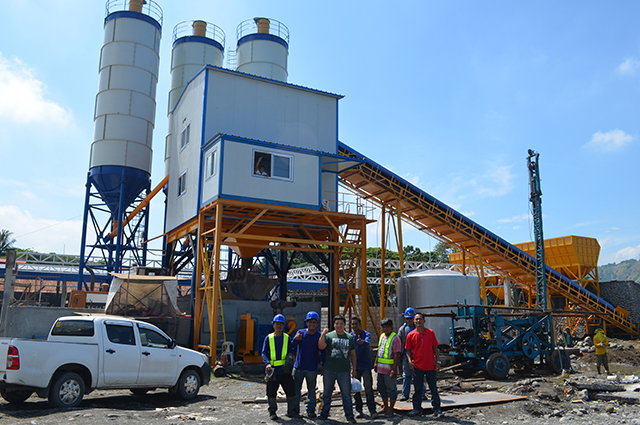
Main Components Of Fixed Concrete Batching Plant
Mixing System
The mixing system is responsible for fully mixing various raw materials to ensure that concrete that meets the requirements is produced. The types of mixing main units include single horizontal shaft, double horizontal shaft, vertical shaft and self-falling type, etc. It is the core equipment of the concrete mixing station.
Control System
The control system is used to manage the entire concrete production process and realize functions such as automatic control, manual control and remote monitoring; it is mainly composed of PLC control system, touch screen operation interface, data storage and management system.
Conveying System
The material conveying system is responsible for conveying various raw materials (such as sand, stone, etc.) from the storage system to the mixing main unit. Common RMC plants include belt conveyors and screw conveyors, which can realize large flow and long distance transportation to ensure smooth material transportation.
Weighing System
The weighing system is mainly divided into aggregate weighing, powder weighing and liquid weighing. Through electronic scales and microcomputer control, various raw materials (such as cement, aggregates, water, admixtures, etc.) can be accurately measured to ensure that the quality of concrete meets the standards.
Storage System
Cement silos are responsible for storing and supplying cement and other powdered materials. They are mainly divided into vertical cement silos and horizontal cement silos. The capacity of cement silos should be determined according to production needs. Choosing the right type of cement silo can improve production efficiency and ensure concrete quality.

How Does A Ready Mix Concrete Plant Work?
The fixed concrete batching plant mainly relies on the automatic control system, through the accurate material distribution and mixing process, raw materials such as cement, sand and some powder materials are measured and weighed proportionally, and the materials are sent to the mixer. Mix thoroughly according to the conveying system.
The modular concrete batching plant uses a two-shaft mixer to carry out an efficient mixing process, the mixer works according to the set time and speed, and the discharge door opens when the concrete mixing is completed. And the concrete is sent to the mixer truck. Each system works together through precise control and efficient material conveying equipment to ensure the stability and efficiency of concrete production.
Belt Type vs. Bucket Type Concrete Batching Plant: Which Is Right for Your Project?
The Main Differences Between The Two Types Of Concrete Batching Plants:
| Differences | Belt Type Concrete Batch Plant | Bucket Type Concrete Batch Plant |
| Structural Form | Material transport using belt conveyors | Use hoppers to transport materials in batches |
| Equipment Area | The area occupied is large, and more space is needed to arrange the conveyor belt and related equipment | Small footprint, compact equipment layout, saving land investment costs |
| Production Efficiency | High mixing efficiency, fast feeding speed, large conveying distance and good conveyor belt stability | The ready mix batching plant production capacity is low and the feeding speed is relatively slow, but the feeding stability is good and accurate feeding can be achieved. |
| Applicable Scenarios | Suitable for large-scale continuous operations; suitable for the production of standard concrete and large-scale infrastructure projects | Suitable for occasions that require high equipment flexibility; more suitable for small and medium-sized projects, especially projects with less extreme production requirements |
| Maintenance | The RMC plant itself may be complex, but maintenance is relatively simple; only regular cleaning, lubrication and inspection are required | Simple structure and relatively low maintenance cost; parts such as hopper and track need to be inspected and repaired regularly |
How to choose the right type?
The best choice depends on the required hourly output, available site area, aggregate handling requirements, installation conditions, and overall investment budget. If the project requires a high production capacity, a belt-type concrete mixing plant can be considered; if a compact layout is preferred, a bucket-type mixing plant is a suitable alternative. The specific configuration scheme shall be confirmed according to the selected model and the actual situation of the project.

How Much Does a Stationary Concrete Batching Plant Cost?
The precast concrete batching plant price varies depending on the model, configuration, production capacity and additional functions. The larger the production capacity, the higher the price of the dry mix concrete plant. The actual purchase should be negotiated based on your specific needs and budget. EPDAS can provide professional purchasing guidance. We provide customized services according to your project needs, and manufacture the concrete mixing plant that best suits your project needs to reduce your investment and improve production efficiency. The following table is the price range of our fixed concrete plant for your reference.
| Model | Concrete Batching Plant Price |
| Bucket type: HZS25-HZS75 | $25,000-$55,000 |
| Belt type: HZS60-HZS240 | $60,000-$210,000 |
What factors affect the price of a concrete plant?
Production capacity
Production capacity is one of the main factors affecting the cost of equipment. Mixing plants designed for higher concrete production often have different equipment configurations than smaller capacity models. Please choose the right capacity according to your expected demand and production plan.
Aggregate feeding system
Belt type and lifting bucket type concrete mixing plants adopt different aggregate conveying methods. The selected system will affect the equipment layout, configuration and overall investment cost.
Cement silo and storage capacity
The number and capacity of cement silos required will depend on daily production demand, raw material distribution frequency and site conditions. Adding storage devices may increase the initial investment, but provide more flexible material reserve capacity.
Mixer and batching system
Mixer model, dosing accuracy requirements, bone silos, weighing systems and related components all affect the final equipment configuration and price.
Transportation and installation
Final project costs may also include transportation, equipment installation, commissioning, foundation construction, electrical works and other site preparation costs. The scope depends on the quotation and the project agreement.
Advantages of Precast Concrete Batching Plant
Modular Overall Design
Compared with the mobile batching plant, the modular stationary concrete batching plant occupies much less space, and the overall structure is modular and compact. The batching machine, mixing main building, screw conveyor and powder tank are all independent structures. It can be quickly disassembled and installed during the move, and it is also easy to transport.
Excellent Mixing Performance
Fully automated batching plant mixing main machine adopts German technology, horizontal shaft forced mixer, which has excellent performance, short mixing time and good homogeneity. Strong mixing performance, uniform and fast mixing. The mixer liner and mixing blade are specially treated, and the unique shaft end support and sealing form greatly improve the service life of the main machine.
Simple Operation Performance
The automatic concrete batching plant is computer-controlled and can be automatically controlled or manually operated. It is easy to operate and easy to master. The dynamic panel allows you to clearly understand the operation of each component. High construction efficiency, shorter waiting time, and improved concrete use efficiency.
Excellent Maintenance Performance
Each maintenance and repair part is equipped with a directly visible aisle or ladder, and there is sufficient operating space to ensure that all operations run smoothly. The fully enclosed structure of the mix and aggregate belt conveyor greatly reduces environmental pollution caused by dust and noise, protecting the health of the surrounding environment.

Cases Of Ready Mix Concrete Batching Plant
EPDAS stationary batching plants have been successfully sold to regions such as South America, Africa, the Middle East, Southeast Asia and Central Asia. Although the climate, terrain and construction requirements of these regions are different, EP concrete batcher plants can adapt perfectly. Our batching plants have a compact structure and small installation area, which can save investment costs and keep the quality of concrete high. We have a professional after-sales service team that can provide equipment commissioning for customers at any time, and have won unanimous praise and high recognition from customers.

Packing & Delivery

Technical Data
| Model: Belt type | Unit | HZS60 | HZS90 | HZS120 | HZS150 | HZS180 | HZS240 |
| Theoretical productivity | m3/hr | 60 | 90 | 120 | 150 | 180 | 240 |
| Mixer model | – | JS1000 | JS1500 | JS2000 | JS3000 | JS3000 | JS4000 |
| Mixing motor power | kw | 37 | 55 | 2*37 | 2*55 | 2*55 | 2*75 |
| Feeding mode | – | Belt conveyor | |||||
| Cycling period | s | 60 | 60 | 60 | 60 | 60 | 60 |
| Max. aggregate size | mm | Ф80 | Ф80 | Ф80 | Ф80 | Ф80 | Ф80 |
| Aggregate bins capacity | m3 | 3*12 | 3*12 | 4*20 | 4*20 | 4*20 | 4*25 |
| Discharging height | m | 4.0 | 4.0 | 4.0 | 4.0 | 4.0 | 4.0 |
| Aggregate weighing precision | – | ±2% | ±2% | ±2% | ±2% | ±2% | ±2% |
| Power weighing precision | – | ±1% | ±1% | ±1% | ±1% | ±1% | ±1% |
| Water weighing precision | – | ±1% | ±1% | ±1% | ±1% | ±1% | ±1% |
| Additive weighing precision | – | ±1% | ±1% | ±1% | ±1% | ±1% | ±1% |
| Model: Bucket type | Unit | HZS25 | HZS35 | HZS50 | HZS75 |
| Theoretical productivity | m3/hr | 25 | 35 | 50 | 75 |
| Mixer model | – | JS500 | JS750 | JS1000B | JS1500B |
| Mixing motor power | kw | 18.5 | 30 | 37 | 55 |
| Feeding mode | – | Hoist bucket | |||
| Cycling period | s | 72 | 72 | 72 | 72 |
| Max. aggregate size | mm | Ф80 | Ф80 | Ф80 | Ф80 |
| Aggregate bins capacity | m3 | 2*6 | 3*6 | 3*12 | 3*12 |
| Discharging height | m | 4.0 | 4.0 | 4.0 | 4.0 |
| Aggregate weighing precision | – | ±2% | ±2% | ±2% | ±2% |
| Power weighing precision | – | ±1% | ±1% | ±1% | ±1% |
| Water weighing precision | – | ±1% | ±1% | ±1% | ±1% |
| Additive weighing precision | – | ±1% | ±1% | ±1% | ±1% |
FAQ
Q1: What production capacity options are available for stationary concrete batching plants?
EPDAS offers solutions for stationary concrete batching plants with capacities ranging from 25 to 240 m³/h. The specific model selection depends on the project’s anticipated concrete demand, work schedule, site conditions, and production requirements. Please contact our team to confirm available models and select the appropriate configuration.
Q2: What is the difference between belt type and bucket type concrete mixing plant?
Belt-type concrete plants use belt conveyors to transport aggregates, which is a common choice for medium and high-capacity production configurations; hopper-type mixing plants use lifting hoppers to feed aggregates into the mixing system, usually with a more compact layout. The optimal choice depends on the required production capacity, site layout, equipment configuration, and project budget.
Q3: What is the price of a stationary concrete batch plant?
The fixed concrete plant price depends on production capacity, feeding system, mixer configuration, cement silo capacity, degree of automation and other optional equipment. Transportation, installation, commissioning, and site preparation may also affect the total project investment. For an accurate quote, please provide your expected capacity, project location and preferred configuration.
Q4: How to choose the right fixed concrete mixing plant model?
First, estimate the expected hourly and daily concrete demand. Subsequently, consider the production plan, project application scenario, available installation space, aggregate supply, cement storage requirements, and local power supply. Taking these factors into comprehensive consideration helps determine the appropriate aircraft type and configuration.
Q5: What site preparation work is required before installation?
Site preparation depends on the selected batching plant configuration and local site conditions. Factors that usually need to be considered include equipment layout, foundation requirements, access and exit roads, aggregate storage yard, cement silo location, power supply, drainage facilities and material transportation channels. Prior to construction, the foundation design and installation plan shall be confirmed according to the equipment drawings and project specific engineering requirements.
Q6: Does EPDAS provide installation and technical support services?
EPDAS may provide technical support according to the agreed scope of supply and service. Depending on the specific arrangement of the project, support services may include equipment technical data, installation guidance, commissioning assistance, operator training and after-sales technical support. Before placing an order, please be sure to confirm the specific service content, delivery terms and related fees with our sales team.
Q7: Can a stationary concrete plant be customized?
Sure. You can select the appropriate configuration based on project requirements and the manufacturer’s technical capabilities. The specific configuration scheme depends on the equipment type and usually involves factors such as production capacity, aggregate feeding system, cement silo layout, mixer configuration, control system and optional equipment. Please provide EPDAS with your project specifications to confirm a feasible customization.
Q8: How long does it take to install a stationary concrete batching plant?
The installation period depends on the type of mixing plant, equipment configuration, foundation preparation, site entry conditions, electrical works and specific installation arrangements. If the project involves a large amount of civil works, it will usually take longer than if the site is ready.